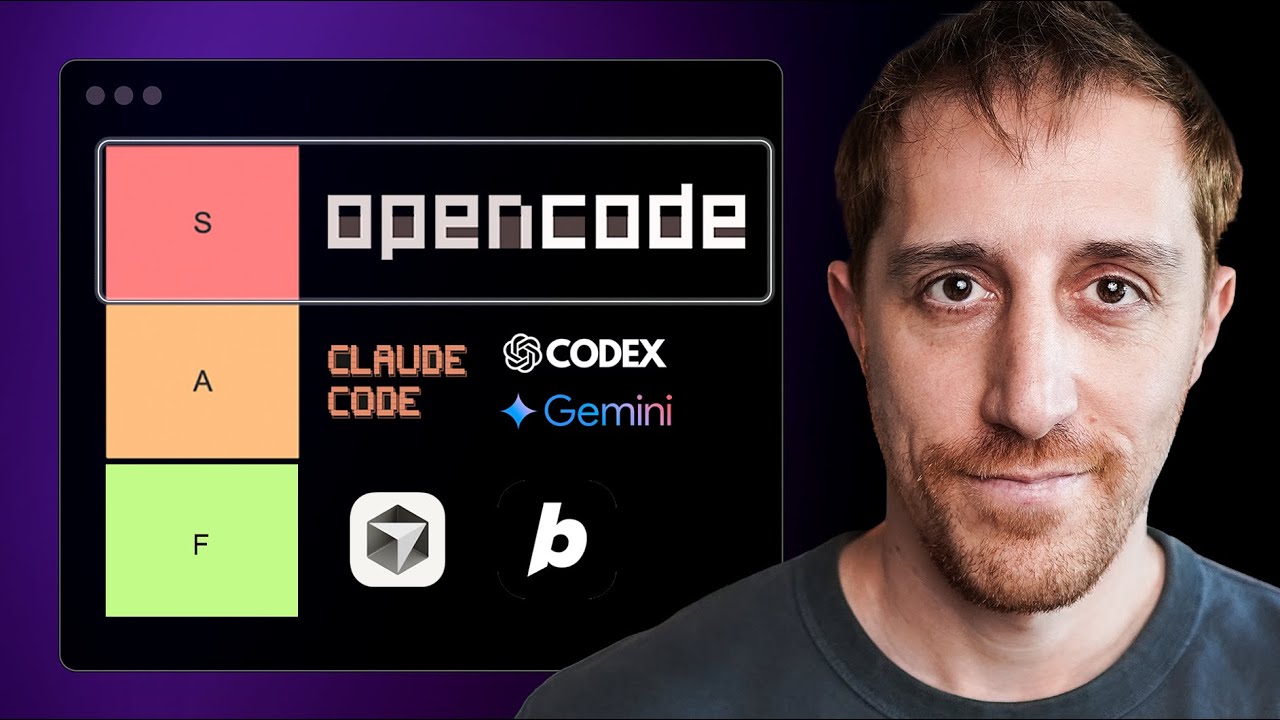
How to Use AI Coding Agents: Tools, Agentic Coding & Safe Adoption
3 Creators3 Videos101 ClaimsPublished 2026-07-07
AI coding agents are reshaping how developers build software, delivering dramatic productivity leaps in prototyping, code review, and routine delegation. As the ecosystem of ai coding agent tools expands, teams must navigate a growing field of assistants to find the best ai coding agent for their workflows. The real promise of agentic coding lies not in replacing developers but in amplifying their capabilities—freeing human creativity to focus on core design and critical thinking. Yet without clear boundaries, the same tools that accelerate delivery can silently weaken architecture and introduce hard-to-detect bugs. Forward-thinking teams are therefore adopting an actionable consensus: embrace ai coding agents immediately for rapid iteration and quality checks, but enforce strict guardrails like agents.md files and explicit architecture boundaries. These lightweight rules ensure that every autonomous suggestion aligns with the project’s long-term vision. As ai coding agent tools mature, the conversation shifts from whether to adopt them to how to scale their usage safely. The most effective engineering cultures pair agentic coding with rigorous human oversight, reserving AI for the repetitive and leaving irreplaceable system design to experienced practitioners. This page explores the top ai coding agent tools, proven practices for agentic coding adoption, and the guardrails that let teams move fast without breaking what works.
SUMMARY
Adopt AI assistants immediately for prototyping and code review, but enforce strict guardrails like agents.md and architecture boundaries to safely scale usage as tools mature.
01Job Market & Future of Software Engineering
Consensus
AI is causing significant displacement in software engineering, with current roles being reduced and transformed into new AI-wrangling roles.
Tom Delalande, Y Combinator and 2 other creators agree.
Unique Insights
Physical jobs like surgeons and plumbers are protected, while knowledge work will face regulatory barriers even when AI is superior, similar to self-driving cars today.
Highlights asymmetric impact across job types and the role of protectionism in slowing AI adoption in regulated fields.
The transition to an AI-driven economy could displace hundreds of millions of people and cause severe societal turmoil for 10 to 20 years, even though long-term may be abundant.
Raises awareness of the painful intermediate period despite eventual optimistic outcomes.
02AI Hype & Media Perception
Consensus
Social media hype around AI coding makes it difficult to discern real capabilities, with many developers skeptical of sensationalized claims and echo chambers.
Tom Delalande, DevOps Toolbox and 2 other creators agree.
Unique Insights
Both the hype that coding is solved and the hatred that AI agents are completely useless are incorrect; the reality is a nuanced spectrum.
Provides a balanced framing that avoids the extremes of current discourse.
03AI Tool Effectiveness & Productivity Gains
Consensus
AI coding tools provide real productivity boosts, enabling faster prototyping and allowing users to create software beyond their pre-existing skill level.
Tom Delalande, Y Combinator and 2 other creators agree.
Diverse Views
How well AI coding tools handle complex production codebases and whether they will soon write any code reliably.
View A: Optimistic: AI capabilities are improving exponentially and will inevitably write any code, delivering 10x productivity across all tasks.
Rapid tool improvement in months, personal 10x productivity, rebuilding blog and vibe coding 35k lines, historical disruption pattern where toys overtake incumbents.
View B: Cautious: AI remains inconsistent for complex tasks, and over-reliance on AI for production code without understanding leads to long-term issues.
Consistency decreases with complexity, debugging is poor, complex projects are not seeing the promised boost, and it's irresponsible to use AI for code you do not understand.
Editor's Note: Early adopters may overestimate near-term capabilities; AI is still best for well-understood, bounded tasks rather than core system architecture.
Unique Insights
No-code tools like Lovable and Replit have improved so much in 6–9 months that a non-current developer was shocked at how good they had become.
Quantifies the breakneck pace of improvement in accessible AI tools.
Complex projects are not seeing the promised productivity boost because AI does not make all tasks more efficient; the trick is understanding which tasks it does well.
Explains why demos don't translate to real-world large-scale gains and underlines selective delegation.
04Vibe Coding
Diverse Views
Whether building entire applications via prompting without reading or understanding the generated code (vibe coding) is a responsible and scalable practice.
View A: Pro: Vibe coding offers extreme productivity, enabling complex apps to be built with zero manual coding in very short time.
Built recipes.ai (voice agent app) without writing a single line, stopped reading code after 5k lines, feels 10x more productive.
View B: Con: Generating production code without understanding it is irresponsible, risks long-term maintainability, and results in poor quality if critical thinking is offloaded.
Tom: irresponsible to use AI for code you don't understand, letting AI handle core problem while you watch YouTube yields terrible code; DevOps Toolbox: the term 'vibe coding' makes me shiver, indicating distaste for blind generation.
Editor's Note: Vibe coding may work for disposable prototypes or personal hacks, but for production systems, lack of code understanding introduces significant technical debt and security risks.
05Code Review
Consensus
AI tools are effective for code review, providing useful feedback and catching potential issues.
Tom Delalande, DevOps Toolbox and 2 other creators agree.
Unique Insights
Using a different model for code review can simulate fresh eyes and provide an unbiased perspective on changes.
A practical tip for improving review quality by avoiding model bias.
06Development Guardrails & Best Practices
Consensus
Developers should establish clear boundaries and instructions for AI agents (e.g., agents.md, architecture patterns) and separate planning from execution to ensure safe and effective use.
Tom Delalande, DevOps Toolbox and 2 other creators agree.
Unique Insights
Domain-driven design and hexagonal architecture with clear separation boundaries reduce the scope of changes and the risk of AI hallucinations leaking between components.
Offers concrete architectural patterns to contain AI-generated code safely.
If an AI tool is not delivering value quickly, stop immediately rather than begging the RNG to succeed; it's a waste of time.
Emphasizes a pragmatic kill switch that respects the probabilistic nature of LLMs.
Open Code's /init command reads existing project files, conventions, and cursor/Copilot rules to automatically generate an agents.md guide.
Lowers the barrier to setting up agent guardrails by auto-extracting project context.
07Adoption & Industry Transformation
Consensus
Adoption of AI coding tools is rapidly increasing among developers and startups, with a significant portion now primarily using AI to write code.
Tom Delalande, Y Combinator and 2 other creators agree.
Unique Insights
Industries like law, education, and medicine that historically bought little software will be transformed in the next five years, creating massive opportunities for startups.
Expands the impact beyond tech into previously resistant markets, signaling a broader shift.
Teams of 2–4 engineers can now build what used to require 40, reducing coordination overhead and leading to dramatically higher product design quality.
Second-order benefit: smaller teams mean clearer ownership and better user experiences, not just cost savings.
08Tool Features & Ecosystem
Unique Insights
Open Code's Zen model router provides a pay-as-you-go model, automatically selecting the latest cost-efficient models without a profit margin.
Challenges the fixed-subscription pricing of tools like Cursor, potentially saving money for occasional users.
Open Code runs a local server and provides a REST API, enabling local file access and custom integrations, plus a GitHub Action that triggers agent jobs from issues.
Local-first architecture with extensive CI/CD integration offers a privacy-friendly and extensible alternative to cloud-only agents.
Using Claude Code, a founder rebuilt an entire blog with hosting and 15 years of posts in 90 minutes on a train.
A striking example of extreme productivity gains using AI coding tools in practical migration tasks.
09AI for Non-Code Tasks
Unique Insights
AI is valuable for research and discovery because it reveals solutions you didn't know existed; hallucinations are acceptable since alternatives can be thrown away at this stage.
Reframes hallucination as a feature during early exploration where broad generation is more useful than strict accuracy.
Using AI to generate a plan risks outsourcing critical thinking and may cost more time reviewing than thinking yourself, because the first suggestion can anchor your thinking.
Cautions against cognitive anchoring and the false efficiency of letting a next-word predictor drive initial design.
LLMs are inconsistent at debugging by nature, making root-cause analysis a poor use case due to their probabilistic operation.
Explicitly identifies debugging as a weak spot, contrary to common assumptions that AI can help fix bugs.
How well AI coding tools handle complex production codebases and whether they will soon write any code reliably.?
Early adopters may overestimate near-term capabilities; AI is still best for well-understood, bounded tasks rather than core system architecture.
Whether building entire applications via prompting without reading or understanding the generated code (vibe coding) is a responsible and scalable practice.?
Vibe coding may work for disposable prototypes or personal hacks, but for production systems, lack of code understanding introduces significant technical debt and security risks.